EDITORIAL
Background. Clinical approbation is one of the mechanisms for introducing new medical technologies into practical healthcare, including them in clinical guidelines and, subsequently, in the public financing system.
Objective. To identify and classify the risks inherent in clinical approbation protocols and to propose a tool for their assessment at the protocol preparation stage.
Materials and Methods. A descriptive, analytical, and content analysis study was conducted. Three 2022 obstetric and gynecological protocols from the register of implemented protocols of the Russian Ministry of Health (2015–2026) were reviewed. Risks were grouped into eight areas, and a risk diagram and a weighted summary risk index (0–30) were constructed for each protocol.
Results. Methodological, documentary, safety, organizational, technological, economic, translational, and legal risks were identified. According to the developed index (0–30), the radiofrequency protocol (19) has a higher risk due to documentation discrepancies and technological dependence. The indices for the rehabilitation and surgical protocols were 16 and 11, respectively. All three protocols were classified as moderate risk. Technological dependence and the risk of overstating conclusions were common to all protocols. A risk mitigation checklist for each area is proposed.
Conclusion. The clinical trial protocol is a source of manageable implementation risks, a significant portion of which are identified at the document level before the results are obtained. The scoring and checklist allow for the early identification of protocol vulnerabilities. Protocol readiness is not the same as implementation: only 13.81% of tested methods are included in clinical guidelines, on average after 2–3 years.
REVIEWS
Introduction. This literature review presents current views on the pathogenesis of uterine scar defects in patients with gestational diabetes mellitus.
The objective of this review was to summarize the literature on uterine scar status, delivery characteristics, and the postoperative course in patients with carbohydrate metabolism disorders, particularly gestational diabetes mellitus, from the perspective of the pathogenesis of this complication.
Materials and Methods. The review includes published data from the past 25 years. A literature search was conducted in Elibrary, Medline, Scopus, Web of Science, Google Scholar, PubMed, Wiley, and the Cochrane Library.
Results. The rate of cesarean section delivery in patients with gestational diabetes mellitus is significantly higher than the general population. Furthermore, carbohydrate metabolism disorders impair uterine scar formation by increasing inflammation, impairing adipocyte migration from the myometrium, and forming a coarse connective tissue scar. This is due not only to inflammatory changes but also to metabolic disturbances at the cellular level, as well as vascular disorders due to endothelial dysfunction. Gestational diabetes is not a direct contraindication to vaginal delivery in patients with a uterine scar, although the risk of uterine rupture in this category of patients is higher than in women without carbohydrate metabolism disorders. It is necessary to carefully consider the range of contraindications to labor induction, particularly macrosomia and obesity, as well as the risk of uterine dysfunction, which collectively worsen the prognosis for vaginal delivery. In the postpartum period, personalized prevention of inflammatory diseases and the formation of an inadequate uterine scar is essential.
Conclusion. A review of the literature revealed that most authors consider carbohydrate metabolism disorders as a risk factor for uterine scar insufficiency/incompetence. However, further research is needed to ensure safe delivery for both mother and fetus in patients with a uterine scar after a previous abdominal delivery and gestational diabetes.
Introduction. The incidence of diminished ovarian reserve (DOR) increases with age: up to 10% in women under 35 and up to 25-50% in women over 40. Among patients seeking ART treatment, DOR is a significant proportion and is one of the main reasons for the decreased success of IVF. The etiology of DOR is multifactorial, and the pathogenetic mechanisms of a significant number of idiopathic and exogenous triggers remain poorly understood.
Objective. To conduct a literature review of the PubMed, Crossref, Medline, and Russian Science Citation Index (RSCI) databases on the causes and pathogenesis of decreased ovarian reserve.
Materials and Methods. A literature search covering 18 years was conducted in the PubMed, Crossref, Medline, and RSCI databases using the keywords “infertility,” “decreased ovarian reserve,” “reproductive age,” “assisted reproductive technologies,” “pathogenesis of decreased ovarian reserve,” “causes of decreased ovarian reserve,” and “factors influencing decreased ovarian reserve.”
Results. Forty-four sources were analyzed and included in the study. The literature data demonstrates a variety of causes for decreased ovarian reserve, each with a different pathogenesis.
Conclusion. This study describes the multifactorial causes and pathogenetic mechanisms of decreased ovarian reserve. It is shown that the complexity and multicomponent nature of the pathogenetic patterns of this process determine the feasibility of further clinical and fundamental study
Introduction. The introduction of preimplantation genetic testing for aneuploidies (PGT-A) into in vitro fertilization (IVF) programs has improved the effectiveness of infertility treatment. However, with the advent of next-generation sequencing (NGS) technologies, clinicians are faced with the problem of embryo chromosomal mosaicism. The feasibility of their use remains controversial and requires an analysis of the accumulated literature.
Objective. Based on an analysis of current literature, this paper presents up-to-date information on the biology of embryo chromosomal mosaicism, the clinical outcomes of mosaic embryo transfer in IVF programs, and practical algorithms for managing this category of patients.
Materials and Methods. A systematic search of scientific publications for the period from 2015 to 2026 was conducted. The review includes original studies, systematic reviews, meta-analyses, and recommendations from professional societies dedicated to embryo chromosomal mosaicism.
Results. The detection rate of mosaicism in PGT-A averages 15–25% and depends on the sensitivity of the diagnostic method, the patient’s age, and the testing protocols. According to current data, low-mosaicity MEs (less than 50%) demonstrate live birth rates comparable to euploid embryos (EEs). Embryo morphological quality is a stronger predictor of transfer success than mosaicism status. ME transfer is associated with a higher risk of miscarriage; however, in the vast majority of cases with ongoing pregnancy, the fetal karyotype is normal.
Conclusion. MEs have real reproductive potential. In the absence of EE, ME transfer is a clinically justified strategy, especially for older patients. Informed patient consent and invasive prenatal testing upon pregnancy to verify the fetal karyotype are mandatory.
ORIGINAL ARTICLES
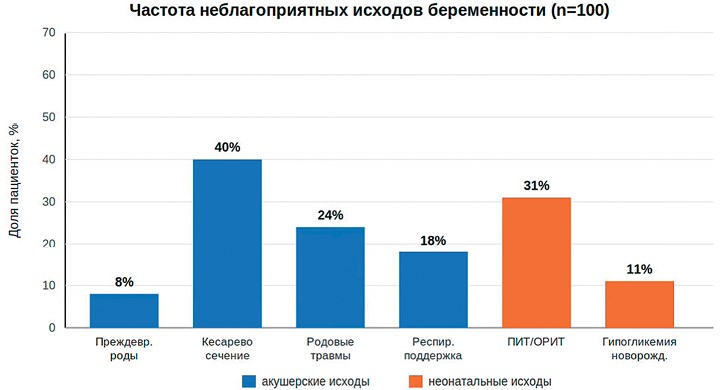
Introduction. Gestational diabetes mellitus (GDM) is associated with an increased risk of adverse obstetric and perinatal outcomes. Self-monitoring of blood glucose using a glucometer reflects only individual measurements and may fail to detect short-term episodes of hyperglycemia and asymptomatic hypoglycemia. Continuous glucose monitoring (CGM) allows the glycemic profile to be assessed over time using integrated metrics, including time in range (TIR). However, the optimal target TIR values for pregnant women with GDM and their association with pregnancy outcomes remain insufficiently studied.
Objective: to assess the impact of achieving the recommended glycemic ranges according to CGM data on adverse pregnancy outcomes in patients with GDM.
Material and methods. A retrospective cohort study was conducted in 100 patients with GDM who were followed up at medical centers of the Sverdlovsk Region and used the FreeStyle Libre 2 CGM system during pregnancy. CGM metrics were calculated over two-week intervals (from 3 to 13 intervals, December 2024 — November 2025) from sensor placement to delivery. Time in range (TIR), time above range (TAR), and time below range (TBR) were assessed. Glucose ranges of 3.5-7.8 and 3.5-7.0 mmol/L were chosen as targets. Patients were divided into groups according to the presence of the studied pregnancy outcomes: preterm birth (<37 weeks), cesarean section (CS), birth trauma, the need for neonatal respiratory support, including Continuous Positive Airway Pressure (CPAP) devices or mechanical ventilation (MV), neonatal admission to the intensive care unit (ICU) or the neonatal intensive care unit (NICU), and neonatal hypoglycemia (<2.6 mmol/L). The Student’s t-test was used to compare the mean values of CGM metrics (p<0.05).
Results. Although TIR was relatively high: 95.1±4.9% (3.5-7.8) and 90.2±7.5% (3.5-7.0); TBR was 1.4±2.0%. No statistically significant differences in TIR and TAR were found between the groups with and without the studied outcomes (p>0.05). In the preterm birth group, a trend toward higher TBR was noted (2.7±5.2% versus 1.3±1.5%), which did not reach significance (p=0.071).
Conclusion. In patients with gestational diabetes mellitus using the FreeStyle Libre 2 continuous glucose monitoring system, high time-in-range values and a low proportion of time below range were observed. No statistically significant associations were found between time in range or time above range and adverse obstetric or neonatal outcomes. However, a trend toward increased time below range was observed in patients with preterm birth, indicating the need for further investigation of the potential role of hypoglycemia in adverse pregnancy outcomes in larger cohorts.
Introduction. Access to specialized medical care for pregnant women is unevenly distributed across the country. For high-risk pregnant women, this means delayed care or the need for urgent transportation. Telemedicine technologies can partially bridge this gap by providing monitoring and timely decision-making without the need for an in-person visit to a specialist.
The objective. To analyze the volume, dynamics, geographic and nosological structure of telemedicine consultations for pregnant women performed at the Ural Research Institute for Maternal and Child Care in 2023–2025, and to assess the role of telemedicine in compensating for the shortage of specialists in remote areas of the Sverdlovsk region and the Ural Federal District.
Materials and methods. A retrospective analysis of the institute’s telemedicine consultation registry was performed. The consultation served as the unit of analysis. The format, territorial distribution, nosological profile and patient routing were assessed. The detailed clinical and organizational analysis included 1857 consultations with a complete set. A descriptive series of 11 federal consultations from 2025 was reviewed separately.
Results. Over 2023–2025, the annual number of telemedicine and remote consultations increased from 659 to 1531, with 3617 consultations performed over the three-year period. In 2025 the Northern administrative district accounted for about 65 % of consultations (723 of 1113), with the town of Serov alone accounting for 510 (46 %). Among consultations with a recorded diagnosis, carbohydrate metabolism disorders predominated: gestational diabetes mellitus accounted for 85.6 %, nearly half of which involved diet-controlled management. Endocrinologists performed 193 consultations in 2025 (about 17 %), which is particularly important for areas without a staff endocrinologist (Krasnoturyinsk, Ivdel, Severouralsk). After teleconsultation, 70–75 % of patients were referred to the institute for delivery and about 10 % for an in-person consultation.
Conclusion. Telemedicine support provides high-risk pregnant women with access to specialized federal-level care regardless of remoteness and local staffing and contributes to selecting patients for delivery at a tertiary center. The predominance of gestational diabetes mellitus defines the endocrinological focus of this work and supports the development of remote glycemic monitoring, the evidence base of which in this condition remains insufficient.
Introduction. Fear of childbirth (tokophobia) is a common phenomenon in perinatal psychology, especially in primiparous women.
Objective. To assess the severity of fear of childbirth and its association with anxiety levels in primiparous women depending on the planned mode of delivery.
Materials and methods. A cross-sectional study included 60 primiparous women divided into two groups: 30 patients with planned cesarean section (CS) and 30 with planned vaginal delivery (VD). The Spielberger State and Trait Anxiety Inventory (adapted by Yu.L. Khanin), the Wijma Delivery Expectancy/Experience Questionnaire (W-DEQ, version A), and an author-developed questionnaire (non-validated, used for qualitative analysis) were administered. Statistical analysis: descriptive statistics, Mann–Whitney U test, χ² test.
Results. Moderate anxiety levels predominated in both groups. The proportion of high state anxiety in the VD group (24.1%) was more than twice that in the CS group (10.0%) (p<0.05). According to the W-DEQ, fear of childbirth (score ≥85) was absent in 100% of women in the planned CS group and present in 12.0% of women in the planned VD group (p<0.05). All three patients with identified fear had high state and/or trait anxiety.
Conclusion. A positive association was found between general anxiety and specific fear of childbirth. Planned cesarean section is associated with the absence of clinically significant tokophobia even in the presence of high trait anxiety. Women planning vaginal delivery and having high state anxiety constitute a risk group for developing tokophobia and require psychological support.
Introduction. Endometrial hyperplasia (EH) is a pathological condition characterized by an imbalance between the glandular and stromal structures of the endometrium, as well as changes in the phenotype of proliferating cells. The key regulators of these processes are HIF-1-alpha, which is responsible for the cellular response to hypoxia, and iNOS, which is induced by inflammation and produces abnormal amounts of nitric oxide. However, the relationship between these processes in endometrial pathology requires further study.
Study Objective. To study the structural features of oxidative, nitrosative stress and their relationship in endometrial hyperplasia (without atypia / with atypia) and endometrioid adenocarcinoma.
Materials and Methods. In a retrospective, non-randomized cohort study, four groups of women (30 participants each, aged 18–45 years) were formed based on the morphological analysis of endometrial biopsies: Group 1: endometrial endometriosis without atypia, Group 2: endometrial endometriosis with atypia, Group 3: endometrioid adenocarcinoma, and Group 4 (control): women with a normal endometrium in the secretory phase of the cycle. Patients who had taken hormonal medications in the past 6 months, or had uterine fibroids, endometriosis, or tumors in other locations were excluded. Histological and immunohistochemical (IHC) analyses were performed using antibodies to HIF-1-alpha and iNOS. Histological specimens were analyzed using QuPath and ImageJ. Statistical data processing was performed in Statistica 13 using the Kruskal–Wallis and Mann–Whitney tests. Differences were considered significant at p<0.05.
Results. In the group with HE without atypia, most cells did not demonstrate HIF-1-alpha expression, and immunopositive cells showed a weak cytoplasmic reaction localized exclusively in the glands. iNOS expression was also noted predominantly in the glands, with an increase closer to their lumina. The relationship between HIF-1-alpha and iNOS was weak. In the 2nd group, with HE with atypia, HIF-1-alpha was expressed in both glands and stroma, with localization in the cytoplasm and nuclei, and iNOS was detected in the same structures. A moderately strong relationship was observed between the markers. In the group with adenocarcinoma, HIF-1-alpha was expressed predominantly in the glands, while iNOS was limited to glandular structures, and the relationship between the markers was virtually absent. In the control group, the expression of both markers was minimal, but a strong correlation was observed between them.
Conclusion. Thus, the results indicate changes in the nature of the correlation between oxidative and nitrosative stress in normal endometrium, in uterine lining hyperplasia, and in endometrial cancer. These changes are due to specific features of metabolic processes in the endometrium and highlight the need for further study and analysis of the pathological changes accompanying uterine pathology.